Complexities and Challenges of Nuclear India by Roshan Khanijo
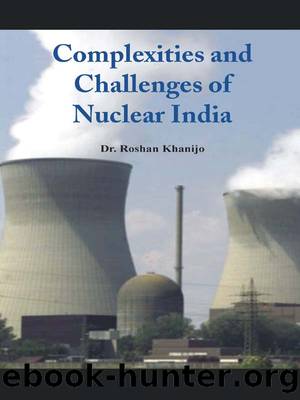
Author:Roshan Khanijo [Khanijo, Roshan]
Language: eng
Format: epub
Tags: Peace, Reference, Arms Control, Military, Security (National & International), Industries, Political Science, Business & Economics, International Relations, Diplomacy, Political Process, World, Political Freedom, American Government, History, General, Nuclear Warfare, Globalization, Energy, Geopolitics
ISBN: 9789384464301
Google: cQqqCQAAQBAJ
Goodreads: 27821228
Publisher: VIJ BOOKS INDIA
Published: 2017-12-11T00:00:00+00:00
Possibility of a NWFZ in South Asia
South Asia has seen the emergence of two Nuclear Weapon States namely India and Pakistan. If the region wants to prevent further proliferation of nuclear weapons and create a NWFZ in South Asia, then it is essential for both these countries to disarm their nuclear weapons. Such a step is not possible at the moment, since both countries have different threat perceptions, and they consider nuclear weapons as potential deterrence factors that would help in maintaining the geo - strategic stability. For India, any talk of nuclear disarmament is linked to broader global nuclear disarmament. It is also important to take into consideration Chinas nuclear status which is an ever looming sword over the Indian peninsular. China on the other hand, is a permanent nuclear weapon state and they have already declared that any talk on disarmament is possible only when US and Russia decrease their nuclear arsenal to the Chinese level. Pakistanâs nuclear programme is linked to the threat they perceive in the Indian nuclear status. The conclusion therefore is that the process of disarmament is a chain reaction, which will require a lot of Confidence Building Measures (CBM) by all the three countries before any substantial result is achieved. However, there are certain regional measures that could speed up the process, for example, both India and Pakistan can help create a South Asian Nuclear Weapon Free Zone by creating the same protocols which has been followed by the P5 nations, especially the protocol I and II of the African Nuclear Weapon Free Zone treaty, Under Article 1, each Protocol Party undertakes not to use or threaten to use a nuclear explosive device against (1) any Treaty Party178 and Protocol II Under Article 1 states, each Party to this Protocol is obligated ânot to test or assist or encourage the testing of any nuclear explosive device anywhere within the African Nuclear Weapon Free Zone.â179. India and Pakistan as NWS can accept the above said protocol by incorporating it in the South Asian Nuclear Weapon Free Zone. Thus by creating a NWFZ in South Asia, they can dissuade other countries from going nuclear, and by giving negative assurances, they can build better relations with nations of this region and prevent further nuclear proliferation.
Download
This site does not store any files on its server. We only index and link to content provided by other sites. Please contact the content providers to delete copyright contents if any and email us, we'll remove relevant links or contents immediately.
Spell It Out by David Crystal(36120)
Life for Me Ain't Been No Crystal Stair by Susan Sheehan(35813)
Cecilia; Or, Memoirs of an Heiress — Volume 1 by Fanny Burney(32563)
The Great Music City by Andrea Baker(32024)
Cecilia; Or, Memoirs of an Heiress — Volume 2 by Fanny Burney(31962)
Cecilia; Or, Memoirs of an Heiress — Volume 3 by Fanny Burney(31945)
Professional Troublemaker by Luvvie Ajayi Jones(29671)
The Secret History by Donna Tartt(19105)
We're Going to Need More Wine by Gabrielle Union(19055)
Twilight of the Idols With the Antichrist and Ecce Homo by Friedrich Nietzsche(18642)
All the Missing Girls by Megan Miranda(16053)
Cat's cradle by Kurt Vonnegut(15365)
Pimp by Iceberg Slim(14523)
For the Love of Europe by Rick Steves(14179)
Bombshells: Glamour Girls of a Lifetime by Sullivan Steve(14082)
Norse Mythology by Gaiman Neil(13379)
Talking to Strangers by Malcolm Gladwell(13378)
Fifty Shades Freed by E L James(13248)
The Social Justice Warrior Handbook by Lisa De Pasquale(12197)
